01Who’s who
Luiz Inácio Lula da Silva (Lula). Re-elected president for a fourth term, for the Partido dos Trabalhadores (PT, Workers’ Party). He takes office on January 5, 2027.
Flávio Bolsonaro. Senator from Rio de Janeiro and the eldest son of former president Jair Bolsonaro. He ran for the Partido Liberal (PL, Liberal Party) and returns to the Senate, where he will lead the opposition.
Dario Durigan. Lula’s finance minister. He has argued that markets treat Lula’s fiscal record unfairly. Whether he stays is the first test for investors.
Rogério Marinho. A senator from the PL and Flávio’s campaign coordinator. How he and Flávio respond to the result in the coming days matters for the political risk premium.
The Centrão. The bloc of centrist parties in Congress. They do not belong to either camp and will decide which of Lula’s fiscal bills pass.
02The result and the first market reaction
Lula won by 3.5 points, a wider margin than any final poll showed, and markets reacted sharply in the first overnight trading.
| Market | October 22 close | October 23 close | First overnight trading (October 25) |
|---|---|---|---|
| Ibovespa | 204,120 | 205,083 (+0.47%) | Ibovespa-linked funds overseas down 11–20% |
| BRL per US$ | 5.038 | 4.993 (BRL +0.9%) | About 5.51 in CME futures (BRL down about 10%) |
| DI Jan-27 | 13.48% | 13.475% | B3 opens Monday |
| DI Jan-29 | 12.66% | 12.595% | B3 opens Monday |
| DI Jan-31 | 12.67% | 12.575% | B3 opens Monday |
| Market | October 22 close | October 23 close | First overnight trading (October 25) |
|---|---|---|---|
| EMBI Brazil | 164bp (Oct 20) | Not available | Not available |
| BRAZIL 5y CDS | 117bp (Oct 20) | Not available | Not available |
| US Treasury 10y | 4.96% | 5.00% | — |
| Brent, US$ per barrel | — | 116.72 (+3.1%) | — |
On Friday, markets were still trading a Flávio win: BRL closed below R$5 per US$ for the first time in the campaign and the DI curve flattened, even as Eurasia Group cut the chance of an opposition win from 70% to 60%. October IPCA-15 inflation also came in lower than expected, at 0.32% for the month and 4.62% over 12 months. That positioning is why the reaction to Lula’s win is so large.
The overnight moves came in thin markets and should be read as a direction, not a level. In 2022, the market did not hit its low on election night. It sold off hardest in Lula’s first days in office, when he extended a fuel tax exemption over his finance minister’s objection.
03What a fourth Lula term means for policy
A fourth Lula term means continuity in economic policy, but he has to deliver fiscal discipline through a Congress controlled by the opposition and the centrist parties.
Lula’s case rests on his record: growth close to 3% a year this term, record-low unemployment, the consumption-tax reform, income-tax cuts for the middle class and the end of the six-day work week. The concern is fiscal. Targets were changed rather than met, and gross debt rose more than 10 points of GDP during his term, to 82.9%.
The 2023 fiscal framework lets spending grow up to 2.5% a year above inflation and sets an annual target for the primary balance. It controls how fast spending grows, not the level of debt. With the Selic at 13.75%, interest costs keep pushing debt up. The economic team has signaled a tighter cap of 1.5%, a review of the health and education spending floors and a pension reform. Each one needs Congress, and the last two need constitutional majorities.
Our view: the framework is credible only if it is tightened. Without the 1.5% cap, we expect debt to rise to 86–88% of GDP by the end of 2027. The market will watch two things first: whether Durigan stays, and whether the 2027 budget contains real cuts or relies on revenue that Congress has not approved.
04Hard-currency sovereign relative value
Dollar bonds should widen much less than local assets. Reserves of US$373bn and little FX debt limit the downside.
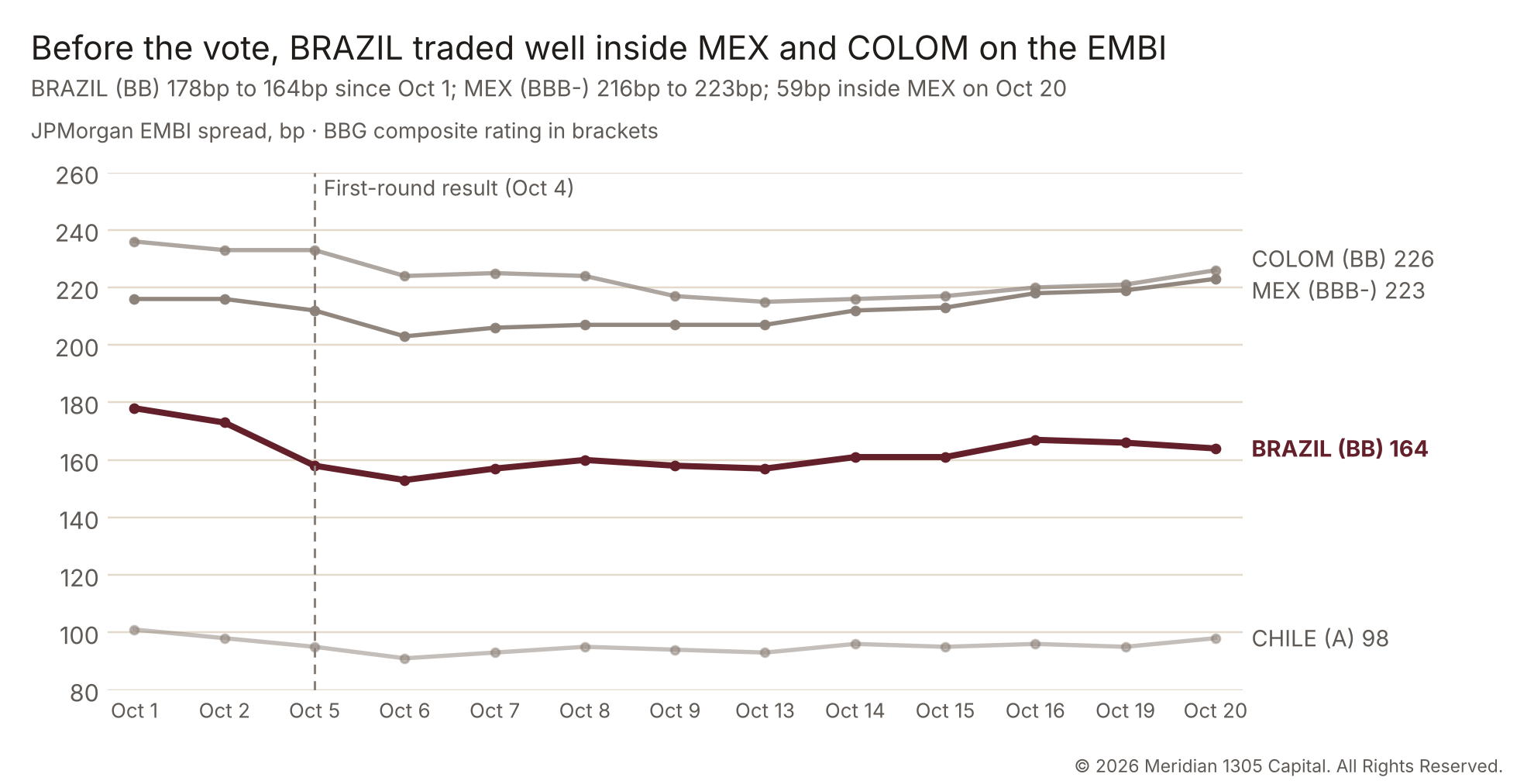
Before the vote, BRAZIL traded at 164bp on the EMBI, 59bp inside MEX (BBB-) and 62bp inside COLOM (BB), even though BRAZIL is rated BB. That premium was built on a Flávio win. In our base case, BRAZIL gives back about 20–40bp of it.
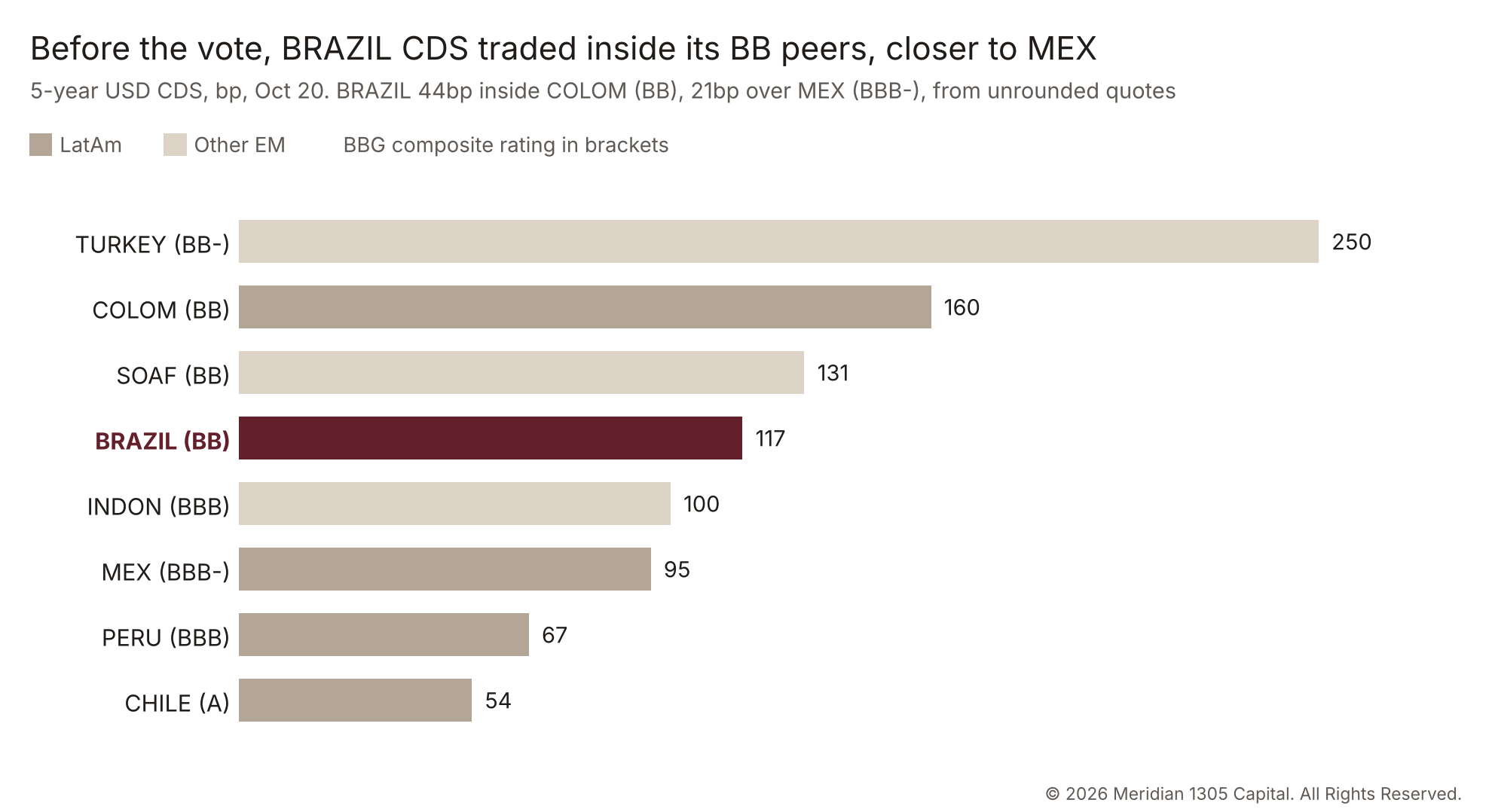
Our view: BRAZIL 5-year CDS at 117bp traded about a notch better than its BB peers. We expect it to move back to the pre-election range of 135–150bp, between MEX (95bp) and COLOM (160bp). We do not expect a crisis-level move, because Brazil’s external position is strong.
05Local rates and BRL
The long end gives back most of its election rally, while the front end stays tied to the Copom.
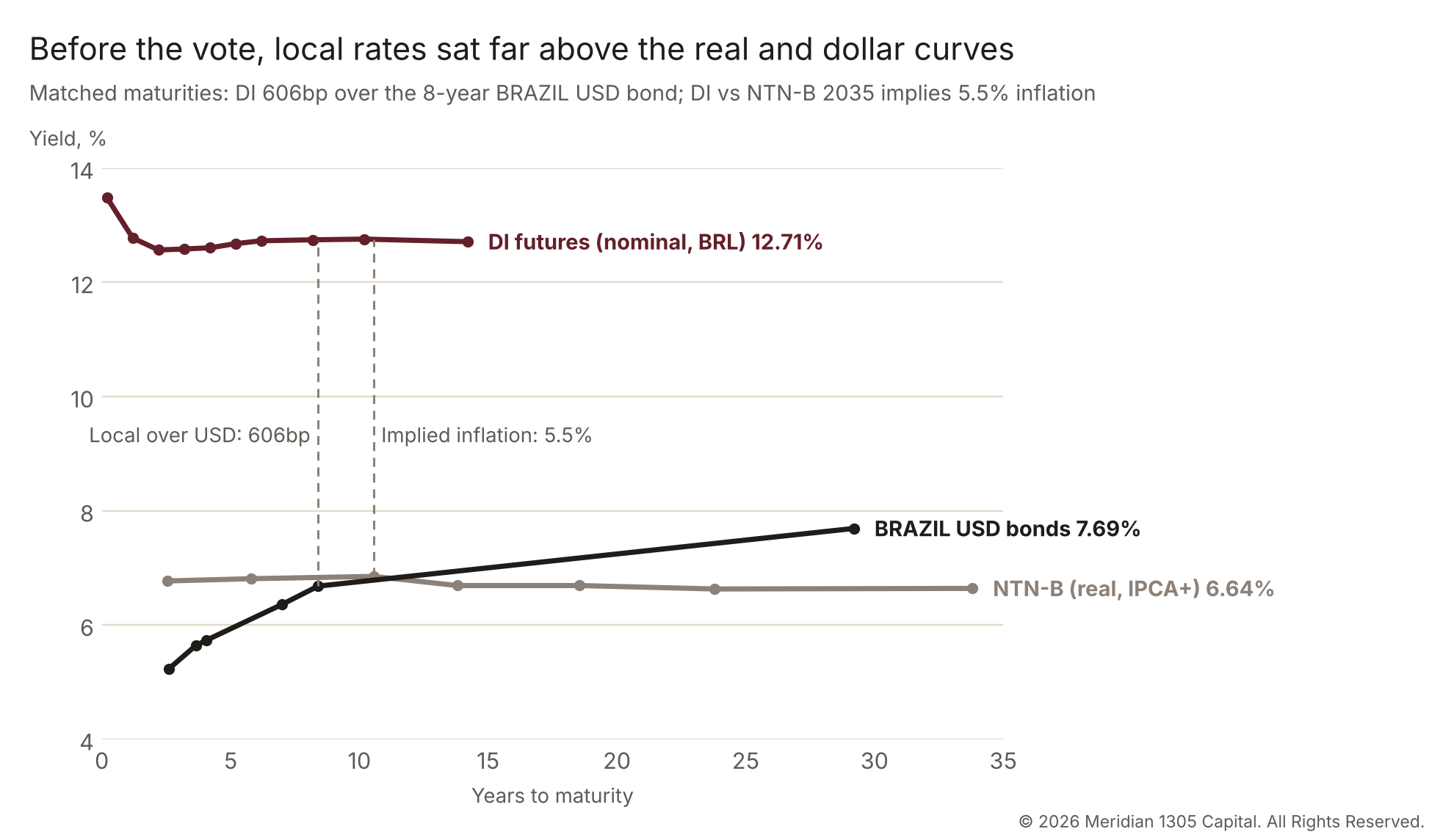
DI Jan-29 fell about 140bp from late August to Friday’s 12.60%, and most of that move was tied to the election. We expect the long end to give back most of it and the curve to steepen. BRL is the easiest way for foreign investors to exit, which is why it moved first and most overnight.
Our view: at R$5.50 or weaker, and with short-term rates near 13.5%, BRL carry becomes attractive again for investors who can hold through the volatility. We would start rebuilding BRL only after the economic team is confirmed.
06Three scenarios for a fourth Lula term
Base case (55%): Durigan stays and the fiscal framework is kept, with a partial attempt to tighten it. Congress blocks new revenue measures. The Banco Central do Brasil steadies BRL, and part of the first move reverses.
Bull case (20%): Lula confirms Durigan and a strong budget team quickly and sends the 1.5% spending cap to Congress early. The centrist parties cooperate on the 2027 budget, and the Copom resumes rate cuts in early 2027.
Adverse case (25%): Durigan is replaced by a political name or Lula announces new spending, such as fuel subsidies. Flávio contests the result. Oil stays above US$115 and the Fed stays hawkish, and the Copom has to raise rates.
Markets, next 3 months
| October 23 close | Base | Bull | Adverse | |
|---|---|---|---|---|
| Ibovespa | 205,083 | 180,000–195,000 | 195,000–210,000 | 160,000–175,000 |
| BRL per US$ | 4.99 | 5.30–5.55 | 5.10–5.30 | 5.70–6.10 |
| Short-term rates (DI Jan-27) | 13.48% | 13.9–14.3% | 13.5–13.8% | 14.5–15.0% |
| Long-term rates (DI Jan-31) | 12.58% | 13.4–13.9% | 12.9–13.3% | 14.3–15.0% |
| Inflation-linked bonds (NTN-B 2035, real yield) | ~6.85% | 7.2–7.5% | 6.9–7.1% | 7.7–8.2% |
| Expected inflation over 10 years (breakeven) | ~5.5% | 5.8–6.1% | 5.5–5.7% | 6.3–6.8% |
| Dollar bond spread (EMBI Brazil) | 164bp (Oct 20) | 185–205bp | 170–185bp | 220–260bp |
| Default insurance (BRAZIL 5y CDS) | 117bp (Oct 20) | 135–150bp | 125–135bp | 165–200bp |
Economy, end-2027
| Latest | Base | Bull | Adverse | |
|---|---|---|---|---|
| GDP growth | 2.0% y/y (Q2 2026) | 1.2–1.6% | 1.6–2.0% | 0.3–0.9% |
| Inflation (IPCA) | 4.62% (IPCA-15, Oct) | 4.7–5.2% | 4.3–4.7% | 5.5–6.5% |
| Policy rate (Selic) | 13.75% | 13.0–13.75% | 12.0–12.75% | 14.5–15.5% |
| Government debt, % of GDP | 82.9% (Aug) | 86–88% | 85–86% | 89–91% |
| Credit ratings (Ba1/BB/BB) | Stable | Stable | Stable | Outlook turns negative |
How we would position
| Base | Bull | Adverse | |
|---|---|---|---|
| Local rates | Short-term rates only; no long duration yet | Buy long-term rates once the team is confirmed | Avoid long-term rates; pay the long end |
| Inflation-linked bonds | Short-dated NTN-Bs as a hedge | Add longer NTN-Bs | Short-dated NTN-Bs only |
| BRL | Rebuild slowly above R$5.50 | Buy | Hedge |
| Equities | Exporters and Itaú: VALE3, SUZB3, EMBJ3, JBSS32, BEEF3, ITUB4 | Add back domestic names: Magazine Luiza (MGLU3), Lojas Renner (LREN3), Cyrela (CYRE3), MRV (MRVE3) | Exporters only; avoid PETR4 and BBAS3 |
| Dollar bonds | Underweight BRAZIL against MEX | Neutral | Underweight BRAZIL; buy CDS protection |
The probabilities and ranges are Meridian 1305 Capital estimates.
07Positioning by issuer
| Issuer | Equity (B3 / US) | USD bonds (Bloomberg) | View |
|---|---|---|---|
| Federative Republic of Brazil | — | BRAZIL | Underweight against MEX; widens toward 185–205bp, but contained |
| Vale | VALE3 / VALE | VALEBZ | Relative winner on a weaker BRL |
| Suzano | SUZB3 / SUZ | SUZANO | Relative winner; USD revenue |
| Embraer | EMBJ3 / EMBJ | — | Relative winner on a weaker BRL |
| JBS, Minerva | JBSS32 / JBS, BEEF3 | — | USD revenue from protein exports |
| Itaú Unibanco | ITUB4 / ITUB | — | Our preferred bank: strong capital and returns |
| Petrobras | PETR4 / PBR | PETBRA | High oil helps, but political-interference risk returns |
| Banco do Brasil | BBAS3 | — | Underperforms on directed-lending risk |
| Magazine Luiza, Lojas Renner | MGLU3, LREN3 | — | First to sell off with higher rates |
| Cyrela, MRV | CYRE3, MRVE3 | — | Sell off with the long end |
08Our highest-conviction calls
- Short-term local rates in every scenario. Even after the result, the front end pays close to 9% after inflation. Few emerging markets pay that.
- Exporters over domestic names. Vale, Suzano, Embraer, JBS and Minerva earn in US dollars and gain when BRL weakens.
- MEX over BRAZIL in dollar bonds. BRAZIL was priced for a Flávio win. MEX pays more spread with a higher rating (BBB- against BB).
- Wait for the economic team before adding long duration or BRL. The first 30 days of policy will matter more than election night, as they did in 2022–23.
09What would change our view
The next 30 days will decide how far the sell-off goes.
Acceptance of the result. A concession from Flávio and certification by the electoral court would remove one source of risk. A long challenge would keep BRL and long rates volatile.
The economic team. Confirming Durigan and a credible budget team would limit the sell-off. A political pick would extend it.
The 2027 budget and the spending cap. Sending the 1.5% real spending cap to Congress early would be the strongest signal that fiscal discipline is real.
Congress. Early cooperation from the centrist parties on the budget would reduce the risk premium. Open conflict would add to it.
The Fed on October 28 and the Copom on November 4. A Copom pause would be expected. A rate hike, or a hawkish Fed, would add pressure on BRL.
Methodology
Market data are as of the close of business on October 23, 2026, unless otherwise noted, and all calculations are by Meridian 1305 Capital. Overnight levels from October 25 come from news reports of CME BRL futures and Ibovespa-linked funds trading overseas, and should be read as indicative. EMBI and CDS levels are as of October 20, 2026. Election results are from the Tribunal Superior Eleitoral (TSE, Superior Electoral Court) with 99.8% of ballots counted. Spreads and breakeven inflation are computed at matched maturities. Scenario probabilities and ranges are Meridian 1305 Capital estimates, not forecasts from any outside source.
This report is published by Meridian 1305 Capital for informational purposes only. It is not investment advice, a recommendation, or an offer or solicitation to buy or sell any security or strategy. Views are those of the author as of the publication date and may change without notice. Forecasts and scenario ranges are estimates based on assumptions that may not hold, and actual outcomes may differ materially. Information from third-party sources is believed to be reliable but has not been independently verified and is not guaranteed. Past performance does not indicate future results.
© 2026 Meridian 1305 Capital. All rights reserved. No part of this report may be reproduced or redistributed without prior written permission.